NASA Rise Plush Scam Sites: Do Not Pre-Order From These Websites
NASA Rise Plush Scam Sites: Do Not Pre-Order From These Websites
TL;DR: On 10 April 2026, Artemis II splashed down safely in the Pacific Ocean. By 12 April, multiple fake e-commerce sites (including nasariseplushies.com and nasarise-plush.com) had already appeared online soliciting pre-orders for Rise plushies at suspiciously low prices, with no official NASA licensing, no traceable company behind them, and no product to ship. This is a textbook viral-event pre-order scam. This post breaks down exactly who Rise is, why demand exploded overnight, how these scam sites operate, the specific red flags visible on both domains, and what to do if you have already handed over payment details.
Who Is Rise, and Why Does Everyone Want One?
If you have been anywhere near space news in the past two weeks, you already know the name. But the full story of Rise is worth telling properly, because it is exactly the kind of story that scammers rely on you being too excited to think critically about.
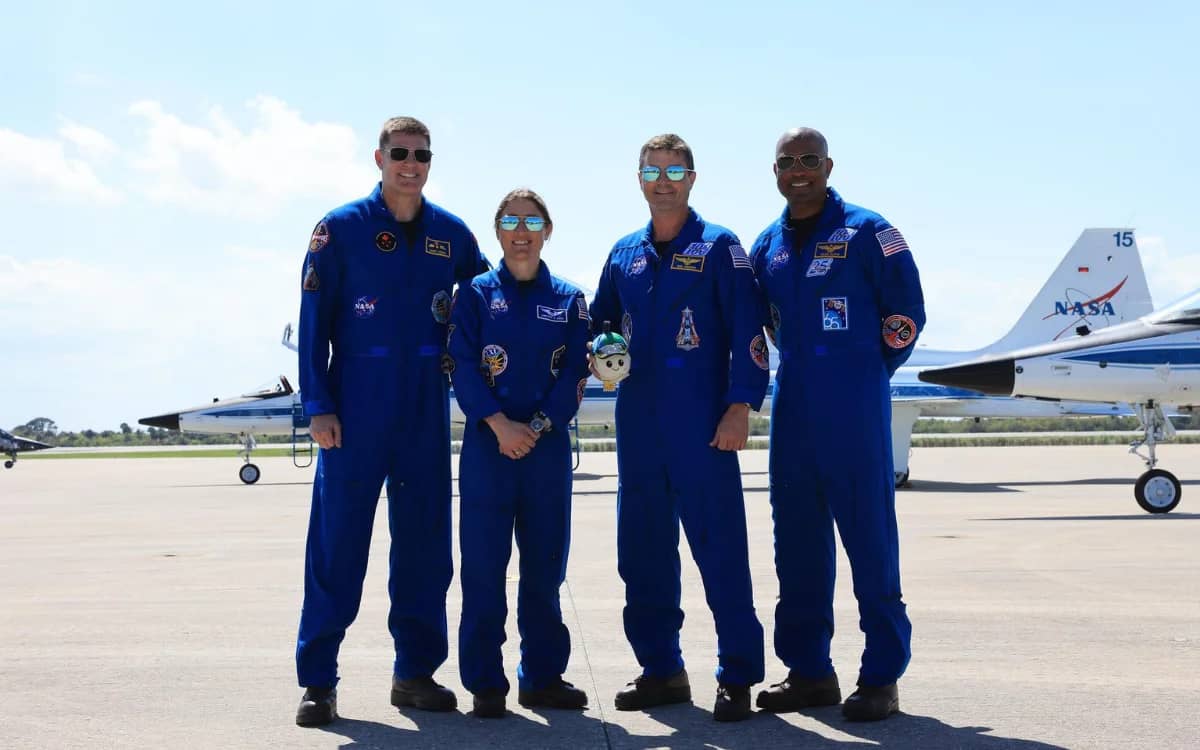
Rise is the zero-gravity indicator and mission mascot that flew aboard Artemis II, NASA's first crewed mission to travel around the far side of the Moon since Apollo 17. The plush was designed by Lucas Ye, an 8-year-old second-grader from Mountain View, California, who entered NASA's design contest run in partnership with crowdsourcing platform Freelancer in March 2025.
Lucas's entry beat 2,605 submissions from more than 50 countries. The Artemis II crew (Commander Reid Wiseman, pilot Victor Glover, and mission specialists Christina Koch and Jeremy Hansen) personally selected Rise as their favourite from a shortlisted five. Lucas told Freelancer he would feel "hyperactive" if his design was actually chosen.
The plush that made the trip was hand-crafted by Pamela Cain, a technician at NASA's Thermal Blanket Lab at the Goddard Space Flight Center, the same lab that normally builds materials to protect satellites. Rise had to pass NASA's rigorous safety standards and carried a hidden pocket containing a micro SD card holding 5.6 million names submitted through NASA's "Send Your Name with Artemis" programme. Millions of people had a piece of themselves aboard the mission.

Every design detail carries meaning. The round white body represents the Moon. The baseball cap is a direct reference to the "Earthrise" photograph taken by astronaut Bill Anders during Apollo 8 in December 1968, the first crewed journey around the Moon and one of the most consequential photographs ever taken. A tiny footprint on the back references Neil Armstrong's 1969 landing. The visor is decorated with galaxies, rockets, and the constellation Orion, which is the name of the capsule. Rise was a deliberate, layered tribute to sixty years of human spaceflight.
Then came the moment that sent Rise viral in a way no PR campaign could have engineered.
Commander Wiseman was supposed to leave Rise inside the Integrity capsule after splashdown. He did not.
"I was supposed to leave Rise in Integrity… but that was not something I was going to do. I stuffed that little guy in a dry bag we had in our survival kit and hooked the bag onto my pressure suit."
— Commander Reid Wiseman, via social media after splashdown
Wiseman was photographed holding Rise on the flight deck of the USS John P. Murtha. He was photographed reuniting with his family with Rise still in hand. Days later he posted: "It's hard not to love this little guy. I can't let Rise out of my sight… currently tethered to my water bottle."
An astronaut smuggling a handmade plush made by an 8-year-old out of a Moon-orbiting spacecraft because he could not bear to leave it behind. That is the story. It reached hundreds of millions of people within 48 hours.
Scammers were watching.
The Scam Sites: nasariseplushies.com and nasarise-plush.com
Within days of Artemis II's splashdown, at least two fake e-commerce websites appeared advertising Rise plushies for pre-order sale:
nasariseplushies.comnasarise-plush.com
Neither site is affiliated with NASA. Neither holds any official NASA licensing agreement. NASA has not announced any authorised retail release of a Rise plush. The only Rise that exists is the singular hand-crafted one currently tethered to Commander Wiseman's water bottle.
These sites are collecting real money for a product they cannot deliver.
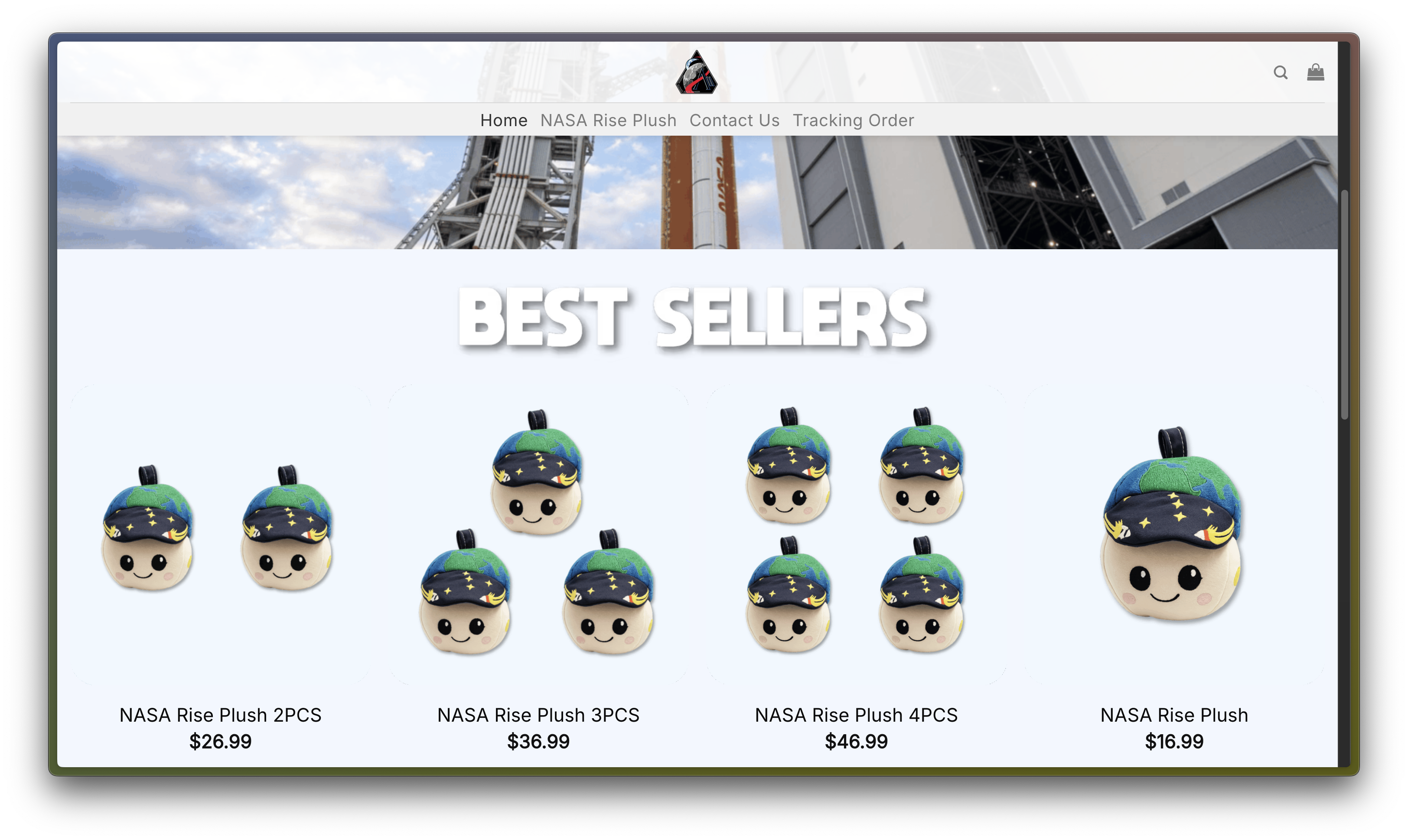
The screenshot above shows nasarise-plush.com as it appeared on 12 April 2026. A close look at what is visible reveals a site assembled rapidly to capitalise on the Artemis II news cycle, with multiple tells that experienced online shoppers should recognise immediately.
How the Pre-Order Scam Works
Pre-order scams targeting viral consumer products follow a predictable and well-documented playbook. Understanding each stage makes the individual red flags easier to spot.
Stage 1: Domain Registration Timed to the News Cycle
Scammers running these operations monitor trending topics continuously. The moment a product, event, or character achieves viral velocity (measured by search volume spikes, social media engagement, and news pickup), automated systems flag it as a potential scam opportunity.
Domain registration is cheap, fast, and anonymous. A domain like nasariseplushies.com can be registered for under $15, with WHOIS privacy enabled, in under five minutes. The scammer does not need to manufacture anything, arrange any logistics, or contact any rights holders. The entire upfront cost is a domain name and a Shopify or equivalent template subscription.
The timing is deliberate: launch the site while search volume is at its peak and before official licensed merchandise becomes available (if it ever does). Consumers searching for "NASA Rise plush buy" or "Rise plush Artemis" in the days immediately after the story breaks will surface these fake sites in results before any official channel exists to compare against.
Stage 2: A Convincing but Shallow Storefront
Both sites use generic e-commerce templates that create a surface-level impression of legitimacy. The sites load quickly, display product images, and present pricing. This is enough for many consumers who are shopping in a state of excitement rather than scrutiny.
The product images are typically scraped from official NASA media releases, fan renders, or, as appears to be the case here, slightly altered versions of the original Rise design. The visual resemblance to the genuine article is part of the deception.
Stage 3: Collecting Payment Before Any Product Exists
The core of the scam is straightforward: the site accepts payment, typically via credit card, PayPal, or sometimes cryptocurrency, for a pre-order of a product that will never be manufactured or shipped.
Several outcomes are possible after payment:
Outcome A: Complete silence. The site takes payment, sends no confirmation, and becomes unreachable. The domain may be abandoned within weeks.
Outcome B: Fake tracking. The site sends a confirmation email with a tracking number. The number either resolves to an unrelated parcel (a technique called "brushing," where the scammer ships an empty envelope or cheap item to generate a valid tracking event) or points to a carrier that never receives the parcel, with status permanently stuck at "label created."
Outcome C: Indefinite delay. The site sends periodic "shipping delay" updates, stringing the customer along for weeks while making dispute timelines harder to meet.
Outcome D: Credential harvest. The payment form is designed not to process any payment at all but to capture a credit card number, CVV, expiry date, and billing address for use in subsequent fraud. The customer receives no product and later discovers unauthorised charges on the card used.
Key Insight: The presence of a payment form on a website does not indicate a legitimate business. Any website can embed a Stripe or PayPal checkout in under an hour. The form looks identical regardless of whether the business behind it is real. What a form cannot substitute for is a genuine product, a traceable company, and an official licensing agreement.
Stage 4: Exploiting the Dispute Window
Pre-order scams are timed to exploit the limits of consumer dispute windows. Credit card chargebacks typically must be filed within 60 to 120 days of the transaction. A scam site that promises "4-6 week shipping" and sends plausible delay notifications can run out the clock on many victims before they realise no product is coming.
PayPal's Buyer Protection window is 180 days from the date of purchase, which offers more recourse, but the scammer's goal is always to delay long enough that some percentage of victims give up, forget, or miss the window entirely.
Red Flags: What the Screenshot Tells Us
The screenshot of nasarise-plush.com visible above is worth examining closely, because it illustrates exactly what a rapidly assembled scam storefront looks like.
No Official NASA Licensing Badge
NASA licensing is a real and verifiable thing. Official NASA merchandise carries a licensing agreement from NASA's Technology Transfer Program. Authorised retailers display NASA's official licensing marks. Neither nasariseplushies.com nor nasarise-plush.com displays any such badge, because none was issued. The original Rise design is the intellectual property of its creator Lucas Ye, and the Artemis programme is a protected NASA brand. No private retailer can legally manufacture and sell Rise without authorisation from both NASA and the rights holders involved, and no such authorisation has been granted.
Domain Names That Imitate Without Matching
nasariseplushies.com and nasarise-plush.com are crafted to appear authoritative while being clearly unofficial to anyone who pauses to check. NASA's official domain is nasa.gov. All NASA official commerce is conducted through store.nasa.gov or verified licensed partners. Any domain that is not nasa.gov or a formally disclosed licensed retailer is not affiliated with NASA, regardless of how many times the word "NASA" appears in the domain name.
The use of descriptive words like "plushies" and "plush" in the domain, combined with hyphens and informal spelling, is a pattern consistently seen in fast-registered scam domains. It targets keyword searches rather than brand recognition.
The Navigation Menu
The site's navigation reads: Home | NASA Rise Plush | Contact Us | Tracking Order
The inclusion of a dedicated "Tracking Order" page is a consistent tell in dropshipping scam sites and fake storefronts. Legitimate retailers integrate tracking within their order confirmation system or link to the carrier directly. A prominently featured standalone tracking page exists to create the impression of a functional fulfilment operation and to direct complaints somewhere while buying time before customers escalate to a formal dispute.
Suspicious Pricing
The site lists:
- NASA Rise Plush: $16.99
- NASA Rise Plush 2PCS: $26.99
- NASA Rise Plush 3PCS: $36.99
- NASA Rise Plush 4PCS: $46.99
For context: the official Rise was hand-crafted by a NASA technician to meet spaceflight safety standards. Official licensed NASA plush merchandise from authorised retailers typically retails between $25 and $60 for a single item. A price of $16.99 for an officially licensed, freshly released NASA mascot plush would be extraordinary. A price of $46.99 for four (implying a per-unit cost of $11.75) is not consistent with any legitimate licensed merchandise economics.
The pricing is calibrated to the impulse buyer: low enough to seem like a deal, structured in multi-unit bundles to maximise revenue per transaction, and framed as a "Best Sellers" list to create the illusion of popularity and demand.
A Generic Template With No Company Information
The site uses a standard Shopify-style template. There is no "About Us" page, no physical address, no company registration number, no customer service phone number, and no return policy visible. Legitimate e-commerce retailers are required under consumer protection laws in most jurisdictions to display their business registration details and provide a clear returns process. The absence of all this information is deliberate, because disclosing a real company address would allow law enforcement and payment processors to act against the operator.
Warning: An SSL certificate (the padlock icon in your browser's address bar) does not mean a website is safe or legitimate. It means the connection between your browser and the server is encrypted. Scam sites routinely use free SSL certificates from Let's Encrypt. The padlock confirms no one is intercepting your traffic; it says nothing about whether the person receiving your payment is honest.
Is There Any Legitimate Place to Buy a Rise Plush Right Now?
As of 12 April 2026, there is not. There is currently no official NASA-licensed Rise plush available for retail sale, and no official pre-order channel has been announced.
The physical Rise that flew aboard Artemis II is currently with Commander Wiseman. NASA and Freelancer have not publicly announced any retail production run. Any website claiming to sell Rise plushies right now, whether listed as in-stock or pre-order, is selling a product it has no right to manufacture and no ability to deliver.
If NASA authorises an official retail release of Rise, it will be announced through:
- NASA's official website:
nasa.gov - NASA's official social media channels (verified accounts with the blue tick, named
@NASA) - Freelancer's official communications regarding Lucas Ye's design
Any announcement will be widely covered by major news outlets. An official purchase link will originate from nasa.gov or a named, verifiable licensed partner, not from a domain registered two days after a splashdown.
What to Do If You Have Already Pre-Ordered
If you have submitted payment to either nasariseplushies.com, nasarise-plush.com, or any similar site, act quickly. Dispute windows are time-limited.
1. File a chargeback immediately with your card issuer. Contact your bank or credit card provider and report the transaction as fraudulent. Provide the website URL, the transaction amount, and the date. Do not wait for a shipping delay to run out; file now, while the transaction is recent.
2. If you paid via PayPal, open a dispute through the Resolution Centre. Log in to PayPal, navigate to the transaction, and select "Report a Problem." Choose "I didn't receive my item." PayPal's Buyer Protection window is 180 days; do not delay.
3. Do not attempt to resolve through the site's contact form. Contacting the scammer directly only informs them that your account is active and delays your chargeback timeline. Escalate directly to your payment provider.
4. If you entered card details, treat the card as compromised. Contact your bank and request a card replacement. Monitor your statements for unauthorised charges. Change the password on any accounts that used the same card for stored payments.
5. Report the site. In Singapore, report to the Singapore Police Force's cybercrime portal at police.gov.sg/iwitness and the Cyber Security Agency at csa.gov.sg/cyber-aid. Internationally, report to the Internet Crime Complaint Center (IC3) at ic3.gov. Reporting helps platforms and registrars act against the domains faster.
The Pattern: Viral Moments Generate Instant Scam Sites
The Rise scam is not an anomaly. It is one instance of a well-established, industrialised pattern that activates within hours of any viral consumer moment.
The operational playbook is consistent across every iteration:
- Monitor social media and search trends for a viral product, character, or merchandise opportunity
- Register plausible-sounding domains while the event is trending
- Deploy a template storefront with scraped product images
- Run paid social media ads (often on Facebook and Instagram) targeting the demographic most likely to be interested, in this case space enthusiasts, parents of young children, and NASA fans
- Collect pre-order payments during the peak of public interest
- Disappear, delay, or deliver nothing
Recent examples of the same pattern include scalper and scam sites that emerged after the original Stanley tumbler shortage, fake pre-order stores that appeared within 48 hours of Palworld's viral launch, and fraudulent Taylor Swift merchandise sites that activated the moment tour dates were announced. The model works because the window of peak viral interest (when consumer desire outpaces rational caution) is real and predictable.
The Rise scam is particularly cynical because it targets an object with genuine emotional resonance. Commander Wiseman's decision to bring Rise home against protocol, the story of an 8-year-old's design flying to the Moon, the 5.6 million names on a micro SD card: these are the details that make people want to own a piece of the moment. The scammers are monetising that feeling, selling the illusion of participation in something that genuinely meant something to millions of people.
Key Insight: The stronger your emotional connection to a product, the less critically you will evaluate the site selling it. Scammers know this. The viral stories that make you most want a product are the same stories that make the most effective setup for a scam.
How to Verify Any Online Store Before You Buy
Whether you are shopping for Rise or any other high-demand product, the following verification steps take under three minutes and catch the vast majority of scam storefronts.
Check the domain age. Tools like lookup.icann.org show when a domain was registered. A domain registered within days or weeks of a viral event that is now selling related merchandise is a serious red flag.
Search for official announcements. Before purchasing any newly viral merchandise, spend thirty seconds searching the brand's official website and social media for an announcement of authorised retail. If no official announcement exists, there is no legitimate product to purchase.
Look for a physical address and company registration. Legitimate retailers display a physical address and (in Singapore) their ACRA registration number. The absence of these details on any e-commerce site is a disqualifying factor, not a minor omission.
Check for reviews on independent platforms. Search [site name] + reviews or [site name] + scam. Scam sites often have no review history, or reviews that appear only on their own pages. Trustpilot, Google Reviews, and Reddit are useful independent sources.
Verify the payment method. If a site accepts only cryptocurrency, wire transfer, or unusual payment processors with no buyer protection, treat this as disqualifying. Legitimate retailers accept credit cards with chargeback rights precisely because they intend to deliver.
Look up the brand's official licensing. For NASA merchandise specifically: any product not sold through nasa.gov or a named licensed partner listed on nasa.gov is not officially licensed. The same principle applies to any major intellectual property: Disney, Marvel, sports leagues, and major entertainment brands all publish authorised retailer lists.
Key Terms Explained
- Pre-order scam: A fraudulent e-commerce operation that collects payment for a product the seller has no intention or ability to deliver, typically timed to exploit a viral moment before any official product exists.
- Domain squatting: Registering a domain name that incorporates a brand, product, or character name without authorisation, typically for resale or to deceive consumers into believing the site is official.
- Chargeback: A payment reversal initiated by a consumer's bank or card issuer when a transaction is disputed as fraudulent or the seller fails to deliver. Must be filed within a window (typically 60 to 120 days for credit cards) from the transaction date.
- Brushing scam: A technique used by scam operations to generate fake tracking numbers. The scammer ships an empty envelope or a cheap unrelated item to generate a real carrier scan, allowing them to mark an order as "shipped" while the actual product never exists.
- SSL certificate: The cryptographic certificate behind the padlock icon in a browser address bar. It confirms the connection is encrypted, not that the website is trustworthy or the business is legitimate. Free SSL certificates are available to anyone.
- WHOIS / ICANN lookup: A public record showing when a domain was registered, when it expires, and where privacy is not enabled, who owns it. Used to verify how long a site has existed.
- Viral-event scam: A broad category of online fraud timed to exploit a news event, viral moment, or product launch. The scammer bets on consumer urgency and excitement overriding due diligence.
- NASA Technology Transfer Program: The official NASA programme through which companies apply for and receive licensing authorisation to use NASA trademarks, logos, and associated intellectual property on commercial products.
References
The following sources informed this post:
- KHOU 11 / Krys Shahin: "Artemis II commander brings beloved 'Rise' plush on journey back to Houston" — Published 11 April 2026. Primary source for Commander Wiseman's account and Rise's post-splashdown journey.
- CBS News: "Zero gravity indicator for Artemis II was designed by an 8-year-old" — Comprehensive account of Lucas Ye's design process, the Freelancer contest, and Rise's construction at Goddard Space Flight Center.
- NASA: Official Artemis II mission documentation and the "Send Your Name with Artemis" programme at
nasa.gov/artemis. - Freelancer: Official press releases regarding the zero-gravity indicator design contest and Lucas Ye's submission.
- ICANN WHOIS Lookup:
lookup.icann.org— For domain registration verification. - Singapore Police Force: Cybercrime reporting portal at
police.gov.sg/iwitness. - Cyber Security Agency of Singapore (CSA): Cybercrime reporting and resources at
csa.gov.sg/cyber-aid. - Internet Crime Complaint Center (IC3):
ic3.gov— US-based international cybercrime reporting.
Ready to build something similar?
Let's discuss how we can engineer this for your business.
Start a Project